



For most home bartenders, a Boston shaker is the right choice. It seals reliably, holds more liquid, cleans in seconds, and lasts for years. The cobbler has one genuine advantage: a built-in strainer that removes the need for a separate tool. But that convenience comes at a cost, and once you have shaken a few hundred drinks, you will feel it.
| Shaker | Biggest advantage | Biggest drawback |
|---|---|---|
| Boston shaker | Fast, durable, easy to clean, high capacity | Requires a separate Hawthorne strainer and a short learning curve |
| Cobbler shaker | Self-contained strainer; no extra tool needed | Cap freezes shut when cold; slower pour; smaller capacity |
Three types appear in most buying guides: the Boston, the Cobbler, and the French (also called the Parisian) shaker. All three are covered below, with a full comparison, pros and cons, a buying checklist for UK shoppers, and technique fixes for the most common problems.
Key takeaways
The Boston shaker is the best choice for most home bartenders: durable, fast to clean, high capacity, and reliable when the technique is learned.
| Point | Details |
|---|---|
| Boston shaker wins for most | Faster, easier to clean, higher capacity, and more reliable than a cobbler for regular home use. |
| Cobbler suits occasional use | Best for infrequent shakers or those who want a self-contained tool; cap-sticking is a real limitation. |
| French/Parisian is aesthetic | Functionally similar to a Boston; choose it for looks, not performance gains. |
| Buy stainless, not plated | Plated finishes flake with use; 18/8 stainless steel is the durable choice at every price point. |
| Nairobibarschool for technique | Hands-on bartending training covers sealing, shaking, and straining with professional equipment. |
Table of Contents
- How does the Boston shaker compare to the cobbler shaker?
- What the Boston shaker does well (and where it asks something of you)
- What the cobbler shaker does well (and where it frustrates)
- How to choose: a buying checklist for UK home bartenders
- Fixing the vacuum seal problem: technique and troubleshooting
- French and Parisian shakers: when the two-piece metal look matters
- Where to buy in the UK and what to expect to pay
- The case for learning proper technique, not just buying the right kit
- Hands-on bartending training at Nairobibarschool
- Sources
How does the Boston shaker compare to the cobbler shaker?
The table below covers every dimension that actually matters at the bar.
| Dimension | Boston shaker | Cobbler shaker | French/Parisian shaker |
|---|---|---|---|
| Ease of use | Moderate (seal takes practice) | Easy (intuitive three-piece) | Moderate (similar to Boston) |
| Built-in strainer | No — needs Hawthorne | Yes | No — needs Hawthorne |
| Seal / vacuum risk | Low with good technique | High (cap sticks when cold) | Low to moderate |
| Control & technique | High — full shake control | Limited by cap and small holes | High |
| Cleaning & storage | Very easy — two pieces | Fiddly — three pieces, small holes clog | Easy — two pieces |
| Capacity | Large | Smaller | Large |
| Durability / material | Excellent — 18/8 stainless steel | Variable — often plated or thin steel | Good — all-metal construction |
| Best for | All cocktail types; professional and home use | Occasional shakers; simple drinks | Aesthetic-focused home bars |
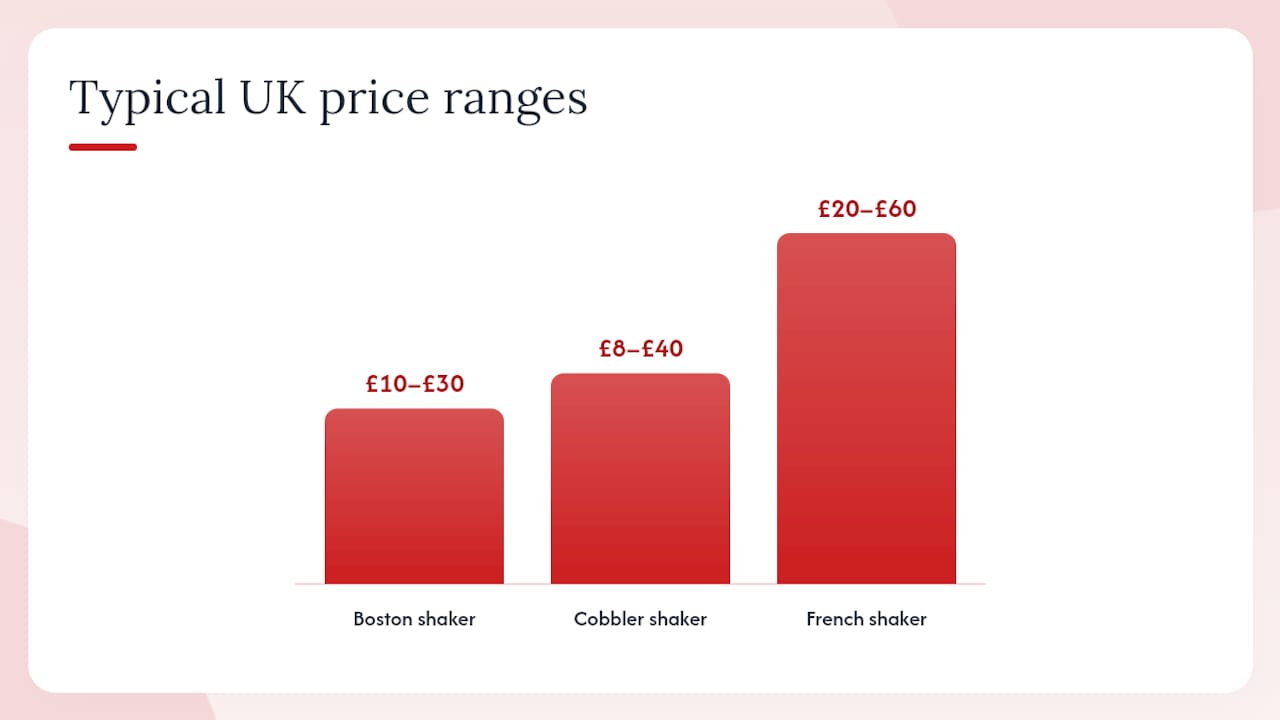
| Typical UK cost | £10–£30 for a reliable tin-on-tin set | £8–£40 depending on quality | £20–£60 |
| Professional vs home | Standard in professional bars | Rarely used professionally | Occasionally used professionally |
The single deciding factor for most home bartenders is the seal. Industry writers and experienced bartenders consistently report that Boston shakers are faster, more reliable, and easier to clean than cobblers, whose built-in strainers slow the pour and whose caps tend to freeze shut after a vigorous shake. For a home bar, a tin-on-tin Boston set plus a Hawthorne strainer sits in the £15–£35 range and will outlast several cobbler kits.
Typical UK price ranges: Entry-level Boston tin-on-tin sets start around £10–£15. A reliable mid-range set with heavier gauge steel runs £20–£30. Quality cobblers range from £12 to £40; anything below £12 is almost certainly thin-plated steel.
What the Boston shaker does well (and where it asks something of you)
The Boston shaker is a two-piece set: a large tin and either a smaller tin (tin-on-tin) or a pint glass (tin-on-glass). You seat the smaller piece inside the larger at a slight angle, tap to seal, shake, then break the seal with a firm heel-of-hand strike at the seam. That is the whole technique.
Pros:
- Holds more liquid than a cobbler, useful for batching multiple drinks
- Two smooth pieces clean quickly
- Metal-on-metal contact chills the drink faster and more evenly
- No cap to freeze shut; the seal breaks cleanly with the right strike
- Preferred by professional bartenders for speed and reliability in high-volume service
Cons:
- Requires a separate Hawthorne strainer (and ideally a fine mesh strainer for egg whites or citrus pulp)
- The seal and break technique takes a few sessions to feel natural
- Tin-on-glass sets carry a small breakage risk; thermal shock can crack the glass if it goes from freezer to hot rinse water
Independent testing by America’s Test Kitchen found that Boston shakers generally seal well and are easier to open than cobblers, many of which leaked or stuck shut when cold. That result matches what bartenders report from real service.
Pro Tip: When buying a Boston tin, pick up the tin and press the wall between your fingers. Good-quality 18/8 stainless steel resists the squeeze; thin-gauge steel flexes noticeably. Tin-on-tin is more durable than tin-on-glass and the better long-term choice for home use. Avoid anything described only as “stainless” without a grade specification.
What the cobbler shaker does well (and where it frustrates)
The cobbler is a three-piece shaker: a tin body, a perforated lid that doubles as a strainer, and a small cap. Pick it up, fill it, shake it, remove the cap, and pour. No separate strainer needed. That simplicity is genuinely appealing, especially for someone making one or two drinks a week.
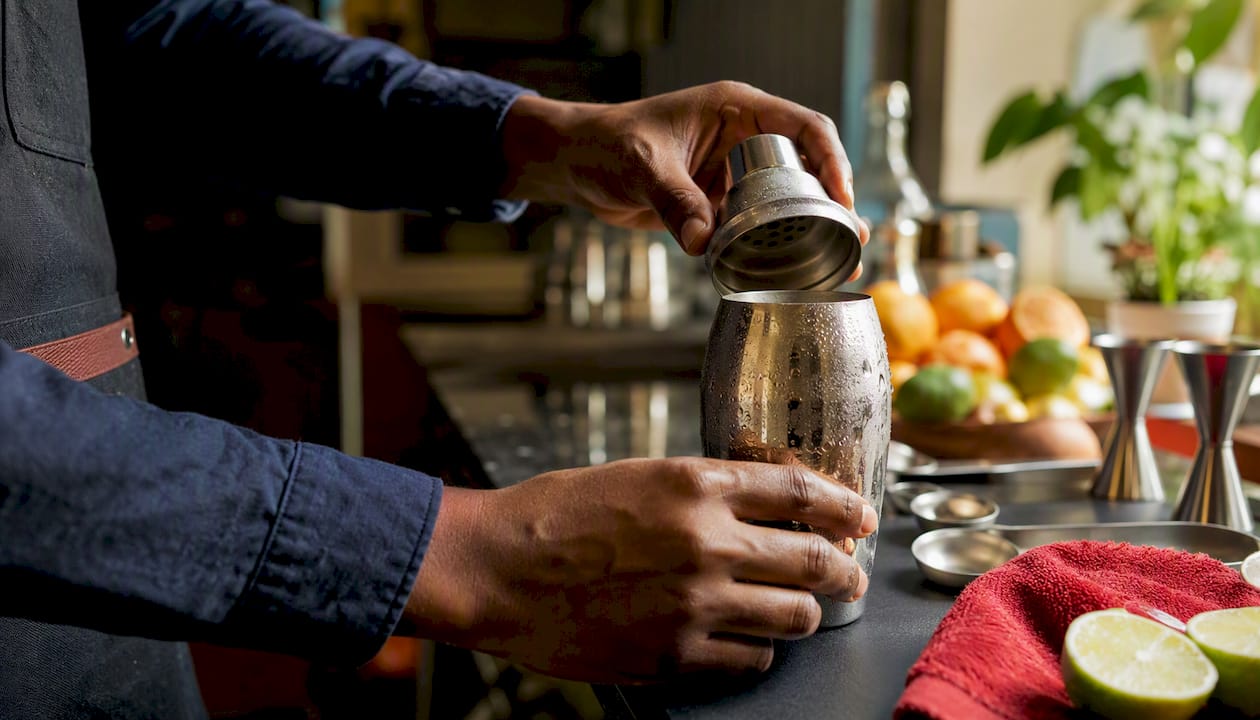
The problems show up quickly in real use. The cap creates a vacuum as the liquid cools and contracts inside the tin. After a hard shake with ice, that cap can lock on so firmly that you are wrestling with it over the sink. Testing confirms that many cobbler models either leaked or became very difficult to open when cold. The built-in strainer holes are often either too small (the pour slows to a trickle) or too large (ice chips slip through). Cheap cobbler kits bundled in starter sets are frequently the worst offenders on both counts.
Where the cobbler genuinely makes sense: infrequent shakers who want a self-contained tool, anyone buying a gift for a home bar, or someone who values the neat silhouette on a bar cart. A well-made cobbler from a reputable brand is a different product from the thin-plated version that comes in a £9 kit.
Pro Tip: To reduce cap-sticking, do not fill the cobbler above two-thirds of its capacity. After shaking, wrap the body in a bar towel and press the heel of your palm firmly down on the cap while twisting. If it still will not budge, run warm (not hot) water over the cap for ten seconds. The slight warming breaks the vacuum without thermal shock.
How to choose: a buying checklist for UK home bartenders
What to look for
- Capacity — choose at least 800 ml for a Boston tin; a cobbler under 500 ml limits you to single serves only.
- Wall thickness — squeeze the tin in the shop or check the product weight online. Heavier means thicker gauge steel.
- Finish — brushed or polished 18/8 stainless steel is the durable choice. Plated finishes (copper, gold) flake with regular use; avoid them for everyday shakers.
- Seal behaviour — for a Boston, the two pieces should seat snugly but not require force to separate when dry. For a cobbler, test the cap fit before buying if possible.
- Included accessories — a Boston set that includes a Hawthorne strainer is worth the small premium; otherwise budget an extra £5–£15 for a separate one.
- Returns policy — buy from a retailer with a clear returns policy. A shaker that leaks on first use should go back without argument.
Questions to ask before buying online
- Is the material listed as 18/8 or 304 stainless steel, or just “stainless”?
- What are the exact dimensions and weight in grams?
- Does the listing show the wall thickness or gauge?
- Are spare parts (cobbler caps, strainer lids) available separately?
Red flags
- No material grade listed beyond “stainless steel”
- Weight under 200 g for a full Boston tin set (almost certainly thin gauge)
- Plated finishes described as “copper-look” or “gold-tone”
- Cobbler strainer holes described as “fine” with no dimension given
- No returns or exchange policy stated
Fixing the vacuum seal problem: technique and troubleshooting
The simplest preventative action is to break the seal promptly after shaking, before the liquid has time to cool the metal further. The physics: rapid chilling causes the metal to contract slightly, tightening the fit between the two pieces. The longer you wait, the harder the break.
Step-by-step: breaking a stuck Boston seal safely
- Hold the tin firmly in your non-dominant hand, fingers wrapped around the body.
- Locate the seam where the two tins meet.
- Strike the upper tin firmly with the heel of your dominant hand at the seam point, angled slightly downward. One clean strike is usually enough.
- If it does not release, rotate the upper tin a quarter-turn and strike again at a new point on the seam.
- Never twist the tins against each other; that distorts the rim over time.
- If the seal is very tight, wrap the body in a warm (not hot) damp cloth for fifteen seconds, then strike again.
For tin-on-glass sets, America’s Test Kitchen testing notes that glass-and-tin combinations behave differently under thermal stress. Never pour boiling water over a cold glass tin, and never move a glass piece directly from the freezer to a hot rinse. Thermal shock can crack the glass cleanly and without warning.
Pro Tip: When working with egg white or fresh citrus pulp, always double-strain: pour through the Hawthorne strainer first, then through a fine mesh strainer held over the glass. A separate Hawthorne strainer handles the bulk; the fine mesh catches the foam and fine particles that the Hawthorne misses. The cobbler’s built-in strainer is too inconsistent for this job.
French and Parisian shakers: when the two-piece metal look matters
The French shaker (also called the Parisian shaker) is a two-piece all-metal design: a large tin body and a smooth metal cap that overlaps rather than seats inside. It looks elegant, which is genuinely its strongest argument. Comparative guides position it as an aesthetic alternative to the Boston, functionally similar but with no meaningful performance advantage.
When a French shaker makes sense:
- You want an all-metal two-piece shaker that looks good on a bar cart or shelf
- You are comfortable with the same sealing and break technique as a Boston
- You prefer the smoother, more uniform silhouette over the Boston’s industrial look
When to look elsewhere:
- High-volume shaking: the French shaker’s overlap seal can be harder to break than a well-made Boston tin
- Budget shopping: French shakers tend to cost more for equivalent steel quality
- Beginners: the technique requirement is the same as a Boston, so there is no simplicity benefit over it
A brief note on other formats: mixing glasses are the right tool for stirred drinks (Martinis, Negronis, Manhattans) where you want dilution without aeration. Novelty shakers shaped like penguins or pineapples are decorative objects, not functional bar tools. Buy one as a gift; do not rely on it for serious mixing.
Where to buy in the UK and what to expect to pay
UK buyers have several reliable options across different price points.
- Online marketplaces (Amazon UK, eBay UK): the widest selection, but read the material specifications carefully. Filter by weight and look for 18/8 stainless listings. Check seller return policies before ordering.
- Specialist bar supply shops (Cocktail Kingdom UK, Bar Supplies, The Mixing Glass): better-quality stock, knowledgeable descriptions, and the ability to compare weights and finishes. Prices are typically higher but the quality floor is also higher.
- High-street kitchen retailers (John Lewis, Lakeland, TK Maxx): stocking a smaller range, but you can handle the product before buying, which is the best way to assess wall thickness and seal fit.
Price bands to expect:
- Under £15: entry-level Boston tin-on-tin sets; functional but often lighter gauge. Fine for learning.
- £15–£30: reliable mid-range Boston sets with heavier steel; the sweet spot for most home bartenders.
- £30–£60: premium cobblers, artisanal French shakers, or professional-grade Boston tins with weighted bases.
If you buy a Boston set, budget separately for a Hawthorne strainer (typically £5–£15) and a fine mesh strainer (£5–£10). Buyer guides consistently recommend a tin-on-tin Boston plus a Hawthorne as the best long-term home bar investment. That combination covers every cocktail type and will not let you down mid-shake.
The case for learning proper technique, not just buying the right kit
There is a version of this debate that treats shaker choice as purely a hardware question. Pick the right tin, and the drinks follow. That is not quite right.
The Boston shaker’s reputation rests partly on the fact that it forces you to learn something. Sealing, shaking with intention, breaking the seal cleanly: these are small skills, but they compound. A bartender who has learned them on a Boston tin can pick up any two-piece shaker and work confidently. Someone who has only ever used a cobbler tends to struggle when the cap freezes or the strainer clogs at the wrong moment.
The cobbler is not a bad tool. A well-made one, used occasionally, does exactly what it promises. But the argument that it is “easier” is only true in the first five minutes. After that, the Boston’s simplicity wins on every practical measure: speed, cleaning, capacity, and reliability under pressure.
The French and Parisian shakers sit in an honest middle ground: they look better than a Boston, perform about as well, and cost more. If aesthetics matter to you, that trade-off is entirely reasonable. If you are building a working home bar rather than a display piece, the Boston is still the answer.
Hands-on bartending training at Nairobibarschool
Reading about sealing technique is useful. Practising it under the guidance of an experienced trainer is faster and more reliable. Nairobibarschool’s professional bartending and mixology course gives you structured, hands-on practice with the exact equipment covered in this article: Boston tins, Hawthorne strainers, and the full range of shaking and stirring techniques used in working bars.

The course is designed for aspiring hospitality professionals who want to build real, transferable skills, not just watch someone else shake a drink. Trainers bring direct industry experience, and the curriculum covers everything from sealing and breaking technique to double-straining and batch preparation. If you want to move from reading about cocktail shakers to using them with confidence, explore the mixology course and find out how to enrol.
Sources
- Boston Shaker vs. Cobbler Shaker vs. French Shaker: The Main Differences
- The Best Cocktail Shakers of 2025 | America’s Test Kitchen
- Cocktail Shakers: The Type Bartenders Actually Use | The Kind Host
- Boston vs Cobbler vs French Shaker | MixologyRecipe
- Boston Shaker vs Cobbler: Which Cocktail Shaker to Buy