

The kitchen brigade system is a hierarchical staffing model, formally known as the brigade de cuisine, developed by Georges-Auguste Escoffier in the late 19th century. Escoffier borrowed the chain-of-command logic of the French military and applied it to professional kitchens, assigning each cook to a specific station with clear duties and a defined reporting line. The result was a kitchen that could produce consistent food at scale, night after night, without chaos.
At its simplest, the hierarchy runs like this:
- Executive chef / chef de cuisine — overall command of the kitchen
- Sous-chef — second-in-command; runs service when the head chef is absent
- Chef de partie — leads a specific station (sauces, fish, pastry, etc.)
- Commis — junior cook working under a chef de partie
- Apprenti — trainee, often on a formal apprenticeship programme
- Plongeur / kitchen porter — responsible for washing-up and basic kitchen support
Key takeaways
The kitchen brigade system gives every cook a defined station, a clear reporting line, and a shared service rhythm — and that structure is what separates a consistent professional kitchen from a chaotic one.
| Point | Details |
|---|---|
| Escoffier’s military model still holds | The brigade de cuisine’s chain of command underpins every professional kitchen, from fine dining to contract catering. |
| Station duties are specific by design | Each role (saucier, rôtisseur, garde-manger, etc.) owns a defined output so nothing falls through the gaps during service. |
| UK kitchens adapt, not abandon, the brigade | Most British operations combine stations; knowing which roles merge most often makes you a more versatile and employable cook. |
| Mise en place is the brigade’s foundation | No amount of skill compensates for a station that is not prepared before service begins. |
| Practical evidence accelerates progression | Logged competencies, shift reports, and placement references are what UK employers ask for when promoting from commis to chef de partie. |
Table of Contents
- What are the common brigade roles? English and French titles at a glance
- What does each brigade role actually do day to day?
- How does a brigade actually run during service?
- How do UK kitchens adapt the brigade today?
- What training routes lead into brigade roles in the UK?
- The brigade system still matters — here is why trainees should take it seriously
- Sources
What are the common brigade roles? English and French titles at a glance
The table below maps the most common brigade stations, their French titles, and their core responsibilities. A full brigade can exceed 20 roles, though that scale is typically found only in large hotels and fine-dining kitchens.
| English title | French title | Core responsibility |
|---|---|---|
| Head chef | Chef de cuisine | Overall kitchen leadership and menu direction |
| Second chef | Sous-chef | Supervises daily service; deputises for head chef |
| Station chef | Chef de partie | Leads a single station and its junior cooks |
| Sauce cook | Saucier | Prepares sauces, stocks, and sautéed dishes |
| Fish cook | Poissonnier | Handles fish and shellfish cookery |
| Roast cook | Rôtisseur | Manages roasting, grilling, and deep-frying |
| Pastry chef | Pâtissier | Produces desserts, pastries, and breads |
| Larder chef | Garde-manger | Cold preparations, charcuterie, and salads |
| Relief cook | Tournant | Covers any station as needed (swing cook) |
| Butcher | Boucher | Butchery and meat preparation |
| Vegetable cook | Entremetier | Soups, vegetables, and egg dishes |
| Breakfast cook | Breakfast chef | Morning service, eggs, and hot breakfast items |
| Junior cook | Commis | Supports the chef de partie at a given station |
| Kitchen porter | Plongeur | Washing-up, cleaning, and basic prep support |
| Expediter | Aboyeur | Calls orders, coordinates pass, and controls service pace |
Note on combined roles: In most small and medium kitchens across the UK, the saucier and poissonnier roles are merged into one position. The pâtissier often covers boulanger (bread-making) duties as well. Modern brigade charts reflect these practical consolidations rather than the full classical structure.
A full, unabridged brigade is genuinely rare. When you see every station staffed separately, you are almost certainly in a large hotel kitchen or a Michelin-level operation.
What does each brigade role actually do day to day?
Understanding the job title is one thing. Knowing what a role looks like at 6:30 PM on a Saturday is another.
The chain of command in practice
The reporting structure flows in one direction:
Executive chef → Sous-chef → Chef de partie → Commis → Kitchen porter
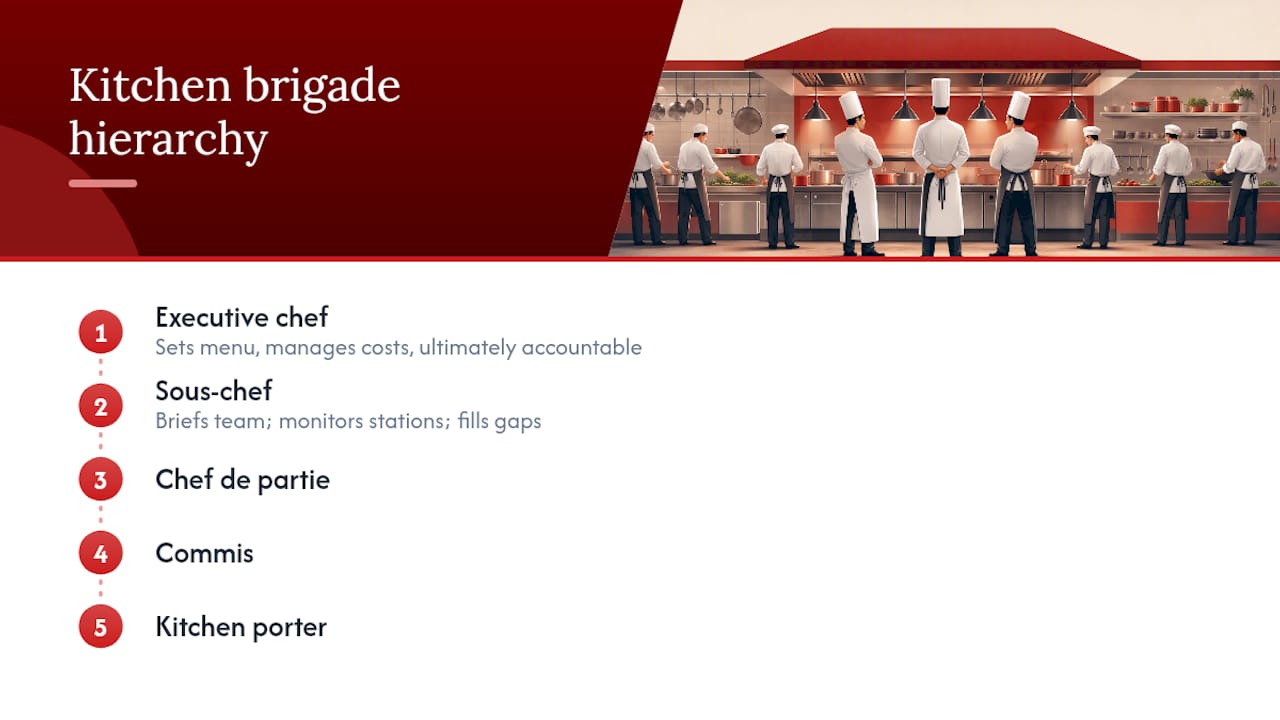
The executive chef sets the menu, manages food costs, and is ultimately accountable for everything that leaves the kitchen. In larger operations, this role is strategic rather than hands-on during service. The sous-chef is the operational engine: they brief the team before service, monitor every station during it, and step in wherever a gap appears.
Key station duties
Saucier — the most technically demanding station in a classical brigade. The saucier produces stocks, reductions, and mother sauces, then builds dish-specific sauces to order. They also handle sautéed proteins on many menus.
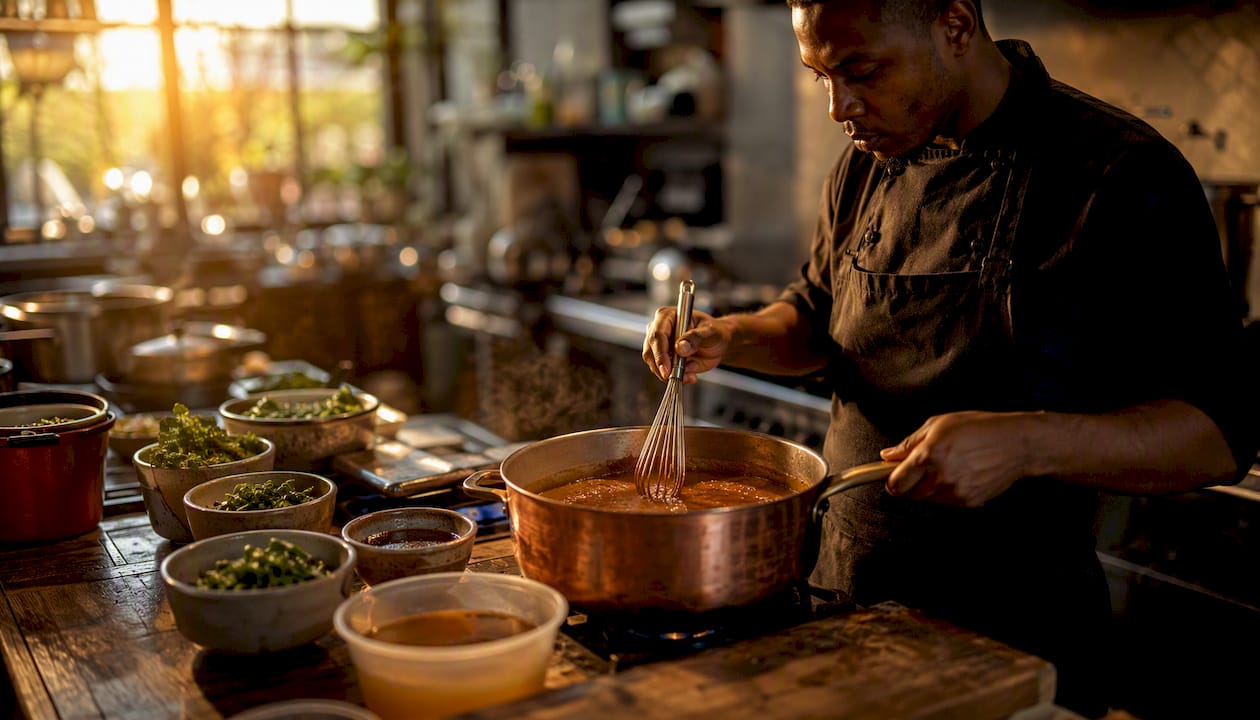
Poissonnier — responsible for all fish and shellfish, from butchery through to plating. In smaller kitchens this station is absorbed by the saucier, since both require similar precision and timing.
Rôtisseur — manages the grill, the oven, and the fryer. On a busy service, this station is relentless: steaks, roasted joints, fried garnishes, and sometimes rotisserie work all land here simultaneously.
Pâtissier — works largely outside the main service rush, producing desserts, pastries, and breads during the day. The role demands precision that is closer to baking science than to reactive cookery. Trainees interested in this path can explore pastry and baking training to build the foundational skills.
Garde-manger — runs the cold section: salads, cold starters, charcuterie, and terrines. In hotel kitchens, this station also handles buffet preparation and canapés for events.
Tournant — the relief cook who covers any station. This is arguably the most demanding role in terms of breadth: a strong tournant must be competent across every section and able to step in without disrupting the rhythm of service.
Boucher — handles butchery and meat portioning. In smaller kitchens this work is done by the rôtisseur or outsourced to a supplier entirely.
In the UK, you will often hear “head chef” used interchangeably with chef de cuisine, and “kitchen porter” (KP) is the standard term rather than plongeur. These are not errors; they are the working vocabulary of British professional kitchens, as High Speed Training notes in its brigade overview.
How does a brigade actually run during service?
Mise en place comes first. Every station prepares its components before a single ticket arrives: stocks reduced, proteins portioned, garnishes prepped, sauces held at temperature. A station that is not mise en place is a station that will fall behind, and one station falling behind can stall the entire pass.
When service begins, the sequence runs like this:
- A table order is taken by front of house and sent to the kitchen, either on a printed ticket or via a point-of-sale screen.
- The aboyeur (expediter) receives the ticket, calls the order aloud to all relevant stations, and logs the time.
- Each chef de partie acknowledges the call and begins cooking their component of the dish.
- As components are ready, they are brought to the pass (the counter between kitchen and front of house).
- The expediter checks every plate for accuracy and presentation before calling front of house to collect.
- Front of house carries the dishes to the table.
The aboyeur is the communication spine of the whole operation. MasterClass describes the expediter as the role that balances front-of-house pace with back-of-house output — and when that role is absent or inexperienced, stations tend to overproduce, queue up, or simply lose track of timing. The most resilient brigades cross-train the tournant to cover the expediter position when needed.
A typical service window
During a typical dinner rush, a brigade might process multiple covers within a roughly one-and-a-quarter-hour service window. The first 30 minutes are usually manageable; the pressure builds when multiple tables order simultaneously and the pass fills with tickets. This is exactly when clear communication from the aboyeur prevents a bottleneck.
Pro Tip: If you are new to a kitchen, spend the first few shifts listening to the expediter’s calls rather than focusing solely on your own station. Understanding the rhythm of the whole service — which tables are mid-course, which are waiting — makes you a far more useful commis than one who only knows their own section.
How do UK kitchens adapt the brigade today?
The classical brigade was designed for a brigade de cuisine of 20-plus cooks. Most UK kitchens operate with far fewer. Fine Dining Lovers notes that modern brigade charts are adapted to the size and style of the operation, and in practice this means significant consolidation.
Common role combinations in UK kitchens
- Saucier + poissonnier: merged in most restaurants with fewer than 15 kitchen staff; one cook handles both sauces and fish.
- Pâtissier + boulanger: the pastry chef bakes bread as part of their daily prep in all but the largest operations.
- Rôtisseur + entremetier: grills and vegetables are often managed by one cook in casual dining settings.
- Garde-manger covering cold starters and dessert plating: common in smaller restaurants where a dedicated pâtissier is not viable.
- Sous-chef acting as aboyeur: in kitchens without a dedicated expediter, the sous-chef calls orders and monitors the pass simultaneously.
How venue type shapes the brigade
Fine dining preserves the most distinct station roles. A two- or three-AA-rosette restaurant in the UK will typically maintain separate saucier, garde-manger, and pâtissier positions, even if each is staffed by just one cook.
Hotel banqueting runs a different model entirely. Volume is the priority: a hotel kitchen producing 300 covers for a wedding breakfast needs speed and consistency over specialisation. Stations are often organised by task (hot, cold, pastry, plating) rather than by classical French title.
High-volume casual dining (pub kitchens, chain restaurants) tends to use a simplified structure: head chef, sous-chef, and a small team of section cooks who rotate across stations. The French titles rarely appear on rotas, but the underlying logic of clear station ownership and reporting lines remains.
Contract catering (hospitals, universities, corporate sites) operates on tight margins and high volume. Brigades here are lean, with multi-skilled cooks covering several stations per shift. The Skiltrak brigade overview illustrates how staffing models differ between hotel and high-volume casual environments.
For supervisors managing a reduced brigade, the practical priority is clarity: every cook must know their station, their reporting line, and who covers them if they fall behind. A written rota that names station ownership for each shift prevents the ambiguity that causes service failures.
What training routes lead into brigade roles in the UK?
Entry into a professional brigade in the UK follows several well-established paths, and most employers value practical evidence of competence as much as formal qualifications.
UK qualifications and apprenticeships
| Qualification / route | What it covers | Best suited to |
|---|---|---|
| Commis Chef Apprenticeship (Level 2) | Basic cookery skills, kitchen safety, mise en place, station work | School leavers entering their first kitchen role |
| Chef de Partie Apprenticeship (Level 3) | Station leadership, menu development, team supervision | Commis cooks ready to step up |
| City & Guilds Level 2/3 Professional Cookery | Technical cookery skills, knife work, classical and modern techniques | College students and career changers |
| NVQ / VRQ in Professional Cookery (Level 1–3) | Competency-based assessment across kitchen tasks | Learners in work-based settings |
| T-Level in Catering (where available) | Broader hospitality and industry placement component | 16–19 year olds in secondary/further education |
| Short specialist courses (pastry, butchery, etc.) | Focused skill development in one station area | Experienced cooks seeking to specialise |
How on-the-job progression typically works
Most brigade careers follow a recognisable arc: commis for one to two years, then chef de partie once station competence is demonstrated, then sous-chef when leadership skills develop, and eventually chef de cuisine. The timeline varies enormously by kitchen and individual, but the pattern is consistent across the industry.
What accelerates progression is evidence. UK employers commonly ask for shift reports, logged recipes, and references from placements. Maintaining a brief skills log from every placement you complete gives you something concrete to show at interview, and it forces you to reflect on what you have actually learned rather than just what you have done.
- Keep a notebook or digital log of every technique you practise on shift.
- Ask your chef de partie to sign off on key competencies as you master them.
- Photograph plated dishes (with permission) to build a visual portfolio.
- Seek feedback after service, not just when something goes wrong.
Practical training programmes that replicate brigade shifts, including timed mise en place and simulated service, shorten the learning curve and give trainees measurable competence when applying for commis and chef de partie roles. Nairobibarschool’s culinary arts programme is built around exactly this approach: hands-on sessions in realistic kitchen environments, with experienced trainers who have worked in professional brigades.
The brigade system still matters — here is why trainees should take it seriously
There is a tendency among newer trainees to treat the brigade system as historical trivia: Escoffier’s thing, relevant to French fine dining, not to a pub kitchen in Leeds or a hotel in Edinburgh. That view misses something important.
The brigade is not really about French titles. It is about the principle that every person in a kitchen knows their job, their reporting line, and their station’s output. That principle scales down to a three-person kitchen just as effectively as it scales up to a 25-person brigade. When a small kitchen fails during service, the cause is almost always the same: unclear ownership of tasks, no one calling the pass, and cooks who do not know what the person next to them is doing.
Trainees who understand the brigade structure from the start have a genuine advantage. They know how to read a kitchen’s hierarchy on their first shift, they understand why mise en place is non-negotiable, and they can communicate in the shorthand that professional kitchens use. That is not a soft skill. It is the difference between being useful on day one and spending three weeks confused.
If you are at the start of your culinary career, the most valuable thing you can do is get into a kitchen that runs a proper brigade, even a simplified one, and pay attention to how it functions. Watch the sous-chef. Listen to the expediter. Notice how the tournant moves. The theory in this article will make sense in a completely different way once you have seen it in practice.
Sources
- Brigade de cuisine – Wikipedia
- What Is a Kitchen Brigade System? Modern Brigade De Cuisine Chart
- Understanding the Kitchen Brigade: 16 Common Kitchen Roles – MasterClass
- Kitchen hierarchy explained | The brigade de cuisine
- Kitchen hierarchy explained: the brigade system broken down
- Kitchen brigade: ultimate list of kitchen staff and descriptions